Key Takeaways
- AI Is Changing the Expectations of Daily Life
- Who Is Most Affected
- Devices Are Not Enough
- Why Community AI 360 Exists
The digital divide is a term that has been used for decades to describe the gap between people who have access to technology and the training to use it and those who do not. It is a simple idea with serious consequences. As artificial intelligence reshapes how work, education, and everyday services operate, that divide is widening rather than narrowing. Understanding what it is and who it affects is the first step toward doing something about it. The divide is not a single problem with a single cause. It is a combination of access, affordability, confidence, and opportunity, and each of those pieces has to be addressed for the gap to close.
It is also important to be honest about why this matters. A divide is not just an inconvenience for the people on the wrong side of it. It shapes who can work, who can learn, who can access services, and who can participate in decisions that affect their lives. When a technology becomes essential, exclusion from it becomes a form of inequality. That is the situation AI is creating, and it is the situation we are working to change.
AI Is Changing the Expectations of Daily Life
AI is changing the expectations of daily life quickly. Job postings now assume familiarity with AI tools. Schools are integrating the technology into assignments. Government services, healthcare portals, and banking applications increasingly rely on interfaces that assume a baseline of digital comfort. For someone already fluent in these tools, the change is barely noticeable. For someone who is not, each new expectation is another small door that has closed. The pace of this change is part of the problem. By the time a person catches up to one shift, the next has already arrived, and the cumulative effect is a growing sense that the world has moved on without them.
Who Is Most Affected
The people most affected by this divide are not random. They are often older adults who retired before these tools became common, veterans transitioning to civilian careers, residents of rural areas with limited broadband, minority entrepreneurs working without access to formal tech training, and anyone whose life circumstances kept them away from consistent technology education. These are not people who chose to be left behind. They are people who were not invited in. Naming these groups matters, because it reminds us that the divide has a human face. Behind every statistic is a person who wants to participate and is looking for a reasonable way to do so.
Devices Are Not Enough
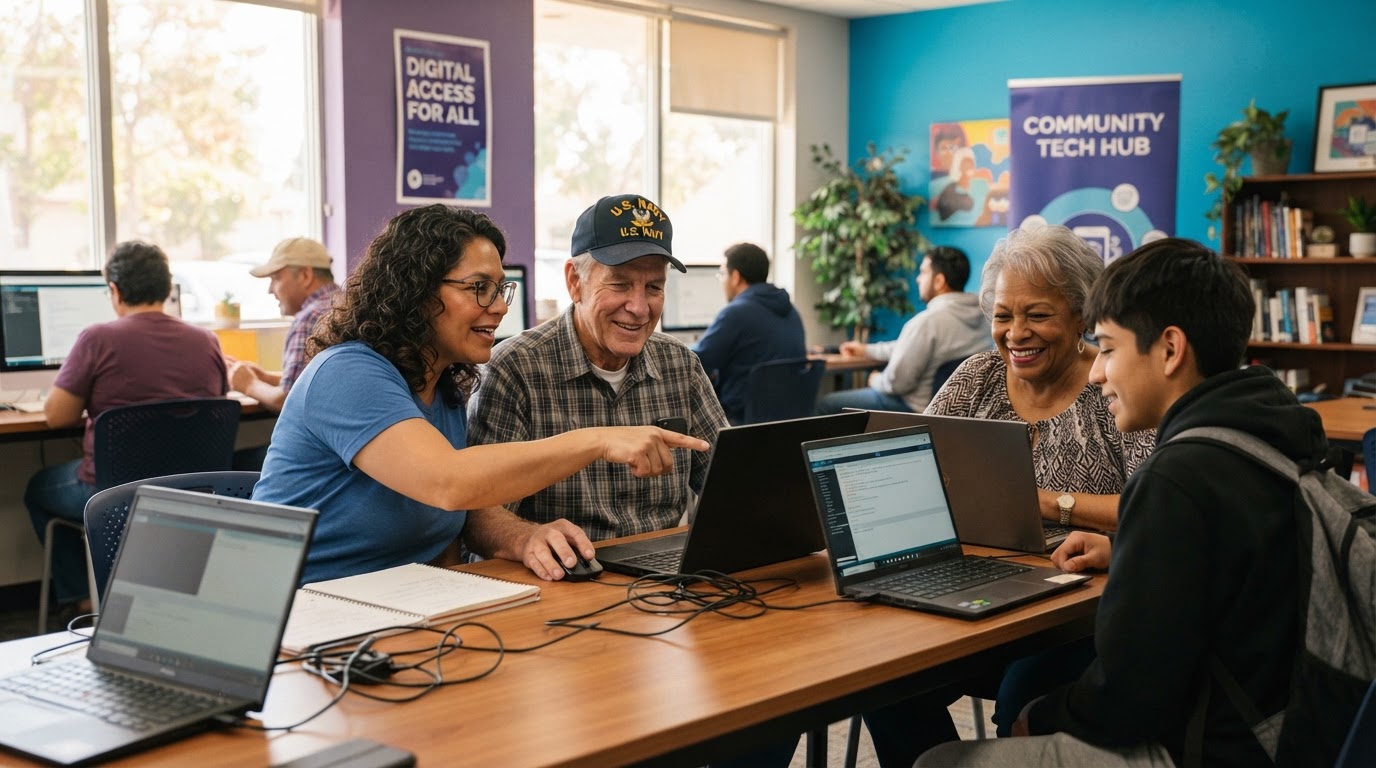
It is tempting to think the solution is simply to give people devices. A laptop or a smartphone is necessary, but it is nowhere near sufficient. A person handed a tool they do not know how to use is not empowered. They are frustrated. The real solution is education that is patient, hands-on, and grounded in the community where the learner already lives. People learn best from people they trust, in places they already feel comfortable, at a pace that respects their lives. A device plus a confident neighbor who can show you the first few steps is worth far more than a device alone. The human support is the part that actually closes the gap.
Why Community AI 360 Exists
This is the gap Community AI 360 was created to address. The mission is not to train a small group of advanced users. It is to make AI education genuinely accessible to the people who have been left out of the conversation so far. That means classes designed for beginners, scholarships so cost is never a barrier, locations that meet people where they are, and instructors who understand that judgment and life experience matter as much as technical skill. We believe that the people most often excluded from technology education are often the ones who benefit most from it, because the skills they gain touch every part of their daily lives.
The Stakes Are Real
The stakes are real. A community where only some people can use the tools shaping the economy is a community with a built-in inequality. Jobs, promotions, small business growth, and even access to information increasingly flow through AI. When a portion of the population cannot participate, the whole community is weaker for it. Closing the divide is not charity. It is an investment in the shared strength of the place we live. A community in which everyone can at least understand and use the basic tools of the moment is more resilient, more prosperous, and more connected than one in which a large share is quietly excluded.
Starting in Hampton Roads
Our approach starts in Hampton Roads, serving Chesapeake, Norfolk, Portsmouth, Suffolk, Hampton, Newport News, and Virginia Beach, with a plan to expand through online programs to communities across Virginia and beyond. The goal is simple to state and difficult to achieve: bridging the AI digital divide, one community at a time. It begins with one learner, one class, one neighborhood, and the belief that everyone deserves the chance to learn. No single organization can close a divide this large, but a community that decides the divide is unacceptable can make steady progress, and that progress is what we are committed to building, one person at a time.
Rate this article
How helpful was this article? Tap a star to share your rating.